> ## Documentation Index
> Fetch the complete documentation index at: /llms.txt
> Use this file to discover all available pages before exploring further.
# Rate Limiting
> Understand API rate limits, HTTP headers, and how to handle 429 errors.
Simiz uses rate limiting to protect the API, ensure stability, and distribute resources fairly across all customers.
## How it works
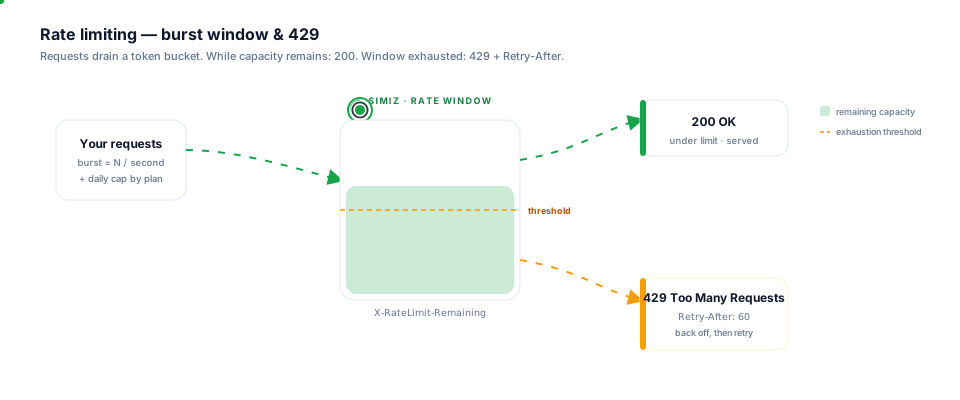 Each API key has a daily request limit and a burst rate (max requests per second) based on your plan. Higher plans offer increased limits.
The **sandbox environment** has relaxed rate limits — test as much as you want during development.
## Rate limit headers
Every API response includes headers to help you monitor your usage:
| Header | Description |
| ----------------------- | --------------------------------------------- |
| `X-RateLimit-Limit` | Max requests allowed in the time window |
| `X-RateLimit-Remaining` | Requests remaining in the current window |
| `X-RateLimit-Reset` | Unix timestamp when the window resets |
| `Retry-After` | Seconds to wait before retrying (on 429 only) |
## Handling rate limit errors
When you exceed the limit, the API returns **HTTP 429 Too Many Requests**:
```json
{
"error": {
"code": "rate_limit_exceeded",
"message": "Rate limit exceeded. Please retry later.",
"http_status": 429,
"retry_after": 60
}
}
```
### Retry with exponential backoff
```bash
# Wait and retry with increasing delays
# Attempt 1: wait 1s → Attempt 2: wait 2s → Attempt 3: wait 4s
```
## Best practices
Cache data that doesn't change often to reduce API calls.
On rate limits, wait with increasing delays between retries.
Monitor `X-RateLimit-Remaining` to anticipate limits before hitting them.
Distribute API calls over time instead of sending bursts.
Need higher limits? [Contact our sales team](mailto:sales@simiz.io) for plans with increased rate limits.
Each API key has a daily request limit and a burst rate (max requests per second) based on your plan. Higher plans offer increased limits.
The **sandbox environment** has relaxed rate limits — test as much as you want during development.
## Rate limit headers
Every API response includes headers to help you monitor your usage:
| Header | Description |
| ----------------------- | --------------------------------------------- |
| `X-RateLimit-Limit` | Max requests allowed in the time window |
| `X-RateLimit-Remaining` | Requests remaining in the current window |
| `X-RateLimit-Reset` | Unix timestamp when the window resets |
| `Retry-After` | Seconds to wait before retrying (on 429 only) |
## Handling rate limit errors
When you exceed the limit, the API returns **HTTP 429 Too Many Requests**:
```json
{
"error": {
"code": "rate_limit_exceeded",
"message": "Rate limit exceeded. Please retry later.",
"http_status": 429,
"retry_after": 60
}
}
```
### Retry with exponential backoff
```bash
# Wait and retry with increasing delays
# Attempt 1: wait 1s → Attempt 2: wait 2s → Attempt 3: wait 4s
```
## Best practices
Cache data that doesn't change often to reduce API calls.
On rate limits, wait with increasing delays between retries.
Monitor `X-RateLimit-Remaining` to anticipate limits before hitting them.
Distribute API calls over time instead of sending bursts.
Need higher limits? [Contact our sales team](mailto:sales@simiz.io) for plans with increased rate limits.