> ## Documentation Index
> Fetch the complete documentation index at: /llms.txt
> Use this file to discover all available pages before exploring further.
# Simiz Provider Protocol
> The strict opt-in exchange standard for connecting a provider to Simiz — payload, vocabularies, certification, one-paste adapter, and JSON Schema. Simiz orchestrates, the provider executes (non-custodial).
The **Simiz Provider Protocol** is the formal, **opt-in**, and **strict** exchange contract between a provider (Mobile Money operator, bank, aggregator) and Simiz. You implement this standard once, certify against the real pipeline, and become routable — without Simiz having to map your proprietary schema.
Simiz is **non-custodial orchestration**: the provider **executes** payments on its own licensed
rails; Simiz **orchestrates** routing, monitoring, and reconciliation. Simiz does not hold funds
and does not host your adapter.
## Webhook or Pull API?
Choose the transport per rail. Both carry the same protocol payloads and the same `idempotency_key`; only delivery changes.
| Use case | Choose | Why |
| ------------------------------------------------------------------------- | ------------ | ---------------------------------------------------------------------------------------------------------- |
| You can expose a stable public HTTPS endpoint and verify HMAC signatures | **Webhook** | Lowest latency. Simiz pushes `health.check`, `payment.execute`, and `payout.execute` to your `baseUrl`. |
| Your core system sits behind a firewall, VPN, NAT, or batch worker | **Pull API** | No inbound exposure. Your worker polls `/v1/provider/orders` with a provider API key, executes, then acks. |
| You need strict network allowlisting or cannot receive internet callbacks | **Pull API** | The provider initiates every outbound connection to Simiz. |
| You need synchronous delivery visibility from Simiz ops | **Webhook** | Simiz sees HTTP status, latency, retries, and bad acks immediately. |
| You need simple migration from file/batch processing | **Pull API** | Polling can run on the same scheduler that already drives your settlement jobs. |
You can run one rail in Webhook mode and another in Pull mode. Do not implement both transports for the same rail unless an operator explicitly opens a migration window; transport changes are audited and the rail must be re-tested before it routes again.
## Health check (Simiz → you)
The protocol has two outbound order transports. With **Webhook**, Simiz sends signed calls to your execution endpoint (`baseUrl`) — the health probe below, the [`payment.execute` order](#payment-execution-simiz-you), and, when payouts are enabled, [`payout.execute`](#payout-execution-simiz-you). With **Pull API**, Simiz stores the same order payloads and your system fetches them from `/v1/provider/orders`.
For **Webhook** rails, when you (or a Simiz operator) click **Test rail** in the portal, Simiz sends a signed `POST` to the **same execution endpoint** (`baseUrl`) you declared in the portal, to prove it holds the rail webhook secret and that your rail answers. The rail is marked **TESTED** only when your handler replies **HTTP 200** with the matching nonce echoed back. Anything else — non-2xx, a wrong or missing nonce, an unreachable host, or a non-HTTPS endpoint — fails the probe, and the rail stays **PENDING** and cannot go live. **Pull API** rails do not declare `baseUrl`; their orders are fetched by API key.
**Request — Simiz → `POST {baseUrl}`**
| Header | Value |
| ------------------- | --------------------------------------------------------------- |
| `Content-Type` | `application/json` |
| `X-Simiz-Signature` | `t={unix_ts},v1={hex_hmac}` — see [signature](#signature) below |
| `X-Simiz-Timestamp` | `{unix_ts}` |
| `X-Simiz-Event` | `health.check` |
```json
{
"protocol_version": "1",
"type": "health.check",
"nonce": "",
"timestamp": 1752489600
}
```
**Your handler must**
1. **Verify the signature** exactly as for inbound events (same scheme, same rail webhook secret `whsec_…`; see [signature](#signature)). Reject with **401** or **403** if it does not match — this is how you confirm the call really comes from Simiz.
2. Respond **HTTP 200** with the nonce echoed back:
```json
{
"type": "health.ack",
"nonce": ""
}
```
Constraints: the endpoint **must be HTTPS**, the probe **times out at \~5 s**, and Simiz marks the
rail **TESTED** only on **`200` + a `nonce` that matches** the one it sent. Echo the exact `nonce`
you received — a wrong or missing nonce is treated as a failed probe.
### Signature
The `X-Simiz-Signature` header uses HMAC-SHA256 for **Webhook transport**. Simiz signs (and you verify) the exact string `` `{timestamp}.{rawBody}` `` — the `X-Simiz-Timestamp` value, a literal dot, then the **raw request body** verbatim — with your rail's **webhook secret** (`whsec_…`), and encodes the digest as hex (the `v1=` part of the header). This is the `generateWebhookSignature` scheme; verify against the raw body **before** parsing JSON. Pull orders are authenticated by provider API key instead; settlement events you push back to Simiz use your provider webhook/channel signing secret.
## Payment execution (Simiz → you)
With **Webhook transport**, when the Simiz router selects your rail for a payment, Simiz sends a signed **`payment.execute`** order to the **same execution endpoint** (`baseUrl`), over the **same envelope** as the health check (same headers, same signature scheme, same shared secret — only `X-Simiz-Event` changes to `payment.execute`). With **Pull API**, fetch the same payload from `/v1/provider/orders`.
**Request — Simiz → `POST {baseUrl}`**
```json
{
"protocol_version": "1",
"type": "payment.execute",
"idempotency_key": "pexec_9f2c...",
"amount": "1500.00",
"currency": "XAF",
"network": "MTN_MOMO",
"country": "CM",
"payee": { "msisdn": "+237670000000" },
"transaction_ref": "TX-2026-000123",
"timestamp": 1752489600
}
```
### Field constraints
| Field | Type / constraint |
| ------------------ | ----------------------------------------------------------------------- |
| `protocol_version` | literal `"1"` |
| `type` | literal `"payment.execute"` |
| `idempotency_key` | non-empty string — **the correlation key** for this order (see below) |
| `amount` | **decimal string**, **major** units — same rule as `SettlementEvent` |
| `currency` | 3-letter ISO-4217 code |
| `network` | same vocabulary as `SettlementEvent` |
| `country` | ISO-3166-1 alpha-2 (for example `CM`) |
| `payee` | **exactly one** of `{ "msisdn": "" }` or `{ "ref": "" }` |
| `transaction_ref` | non-empty string — the Simiz transaction reference |
| `timestamp` | Unix **seconds**, positive integer |
**Your handler must**
1. **Verify the signature** first, exactly as for the health check (401/403 on mismatch).
2. Respond **HTTP 200** synchronously with a `payment.ack` **echoing the `idempotency_key`**:
```json
{
"type": "payment.ack",
"idempotency_key": "pexec_9f2c...",
"status": "ACCEPTED"
}
```
To refuse the order (unsupported corridor, blocked payee, …), reply `"status": "REJECTED"` with an optional human-readable `"reason"`. Anything else — non-2xx, an unparseable body, a wrong or missing `idempotency_key` echo — is treated as a **failed delivery** and the payment is not considered accepted.
3. **Execute the payment on your licensed rail**, asynchronously.
4. **Push the outcome** as a regular inbound [`SettlementEvent`](#settlementevent-payload) to your Simiz webhook, reusing the **same `idempotency_key`** you received (or referencing the same `transaction_ref`). That settlement event — not the ack — is the truth of the outcome: it is what completes or fails the transaction on the Simiz side.
The ack means "**accepted for execution**", never "paid". The protocol has **no status-poll
endpoint**: the settlement event you push is the single source of truth for the outcome, and the
`idempotency_key` is the thread that ties order, ack, and settlement together. Deliveries may be
retried with the **same** `idempotency_key` — treat a key you have already seen as a duplicate and
do **not** execute twice. Simiz retries transient delivery failures (timeout, 502, 503, 504) up to
3 attempts with the same `idempotency_key`.
## Pull transport (you → Simiz)
If you cannot expose a public HTTPS endpoint, choose **Pull API** as the rail's **Order transport** in the portal. The message is still the same `payment.execute` or `payout.execute` payload, but your system fetches it from Simiz with a provider API key instead of receiving a signed webhook POST.
Use a provider API key with `Authorization: Bearer sk_...`:
| Method | Route | Purpose |
| ------ | --------------------------------------------- | ------------------------------------------------------------------------------------------------------------------------------------ |
| `GET` | `/v1/provider/orders?status=pending&limit=50` | Fetch pending orders for the authenticated provider. First delivery is marked `DELIVERED`; orders remain re-deliverable until acked. |
| `POST` | `/v1/provider/orders/:idempotencyKey/ack` | Ack with the exact `payment.ack` or `payout.ack` body. Re-sending the same ack is idempotent. |
| `GET` | `/v1/provider/orders/:idempotencyKey` | Read one order's status for support/debugging. |
```bash
curl -H "Authorization: Bearer $SIMIZ_PROVIDER_API_KEY" \
"https://api.simiz.io/v1/provider/orders?status=pending&limit=10"
```
**Official minimal worker loop — Node**
```js
const SIMIZ_API_URL = process.env.SIMIZ_API_URL ?? 'https://api.simiz.io';
const SIMIZ_PROVIDER_API_KEY = process.env.SIMIZ_PROVIDER_API_KEY;
async function pullOnce() {
const res = await fetch(`${SIMIZ_API_URL}/v1/provider/orders?status=pending&limit=50`, {
headers: { authorization: `Bearer ${SIMIZ_PROVIDER_API_KEY}` },
});
if (!res.ok) throw new Error(`pull failed: ${res.status} ${await res.text()}`);
const { orders } = await res.json();
for (const order of orders) {
const payload = order.payload;
const idempotencyKey = order.idempotency_key;
const accepted =
payload.type === 'payment.execute'
? await executePaymentIdempotently(payload)
: payload.type === 'payout.execute'
? await executePayoutIdempotently(payload)
: false;
const ack = {
type: payload.type === 'payout.execute' ? 'payout.ack' : 'payment.ack',
idempotency_key: idempotencyKey,
status: accepted ? 'ACCEPTED' : 'REJECTED',
...(!accepted ? { reason: 'Unsupported or duplicate order' } : {}),
};
const ackRes = await fetch(`${SIMIZ_API_URL}/v1/provider/orders/${idempotencyKey}/ack`, {
method: 'POST',
headers: {
authorization: `Bearer ${SIMIZ_PROVIDER_API_KEY}`,
'content-type': 'application/json',
},
body: JSON.stringify(ack),
});
if (!ackRes.ok) throw new Error(`ack failed ${idempotencyKey}: ${ackRes.status}`);
}
}
setInterval(() => pullOnce().catch((err) => console.error(err)), 5000);
```
Pull transport authenticates the provider with the API key and TLS. Webhook transport authenticates each pushed order with `X-Simiz-Signature`. Both transports deliver the same v1 payload and use the same `idempotency_key` correlation. If an order is never pulled or acked before `expires_at`, Simiz expires it and fails the correlated transaction or payout.
## Payout execution (Simiz → you)
When a rail is marked **Supports payouts** in the provider portal, Simiz can dispatch **`payout.execute`** orders through the rail's selected transport: signed POST to `baseUrl` for Webhook, or `/v1/provider/orders` for Pull API. This is the outbound money movement contract for salaries, marketplace seller payouts, agent commissions, and refunds that leave a merchant balance.
**Request — Simiz → `POST {baseUrl}`**
```json
{
"protocol_version": "1",
"type": "payout.execute",
"idempotency_key": "pexo_9f2c...",
"amount": "25000.00",
"currency": "XAF",
"network": "MTN_MOMO",
"country": "CM",
"payee": { "msisdn": "+237670000000" },
"transaction_ref": "PO-2026-000123",
"timestamp": 1752489600
}
```
The fields follow the same constraints as `payment.execute`; only `type`, the `pexo_` idempotency prefix, and the business direction change. Reply synchronously with:
```json
{
"type": "payout.ack",
"idempotency_key": "pexo_9f2c...",
"status": "ACCEPTED"
}
```
To refuse the payout, return `"status": "REJECTED"` with a `"reason"`. Simiz never dispatches a payout before its own balance, idempotency, environment, and `supportsPayout` gates pass; your ack only confirms that your rail accepted the order for asynchronous execution. The final truth still comes back as a `SettlementEvent` using the same `idempotency_key`.
## Routing
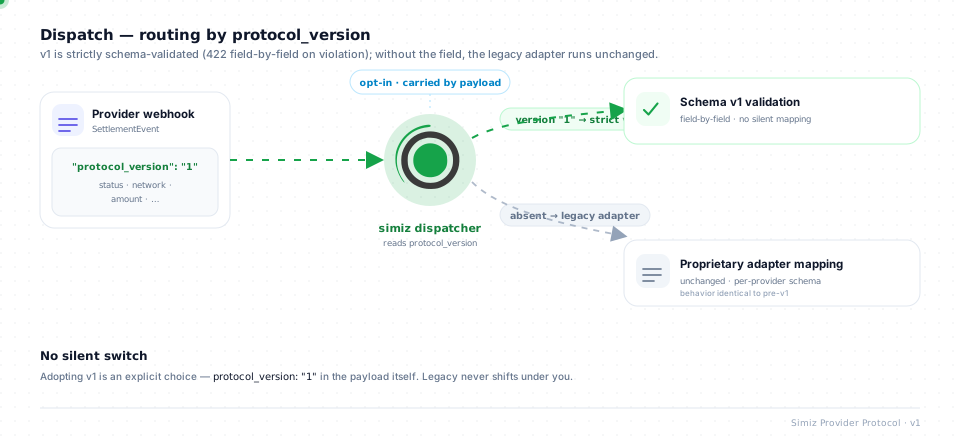 The dispatcher routes based on the **presence of the `protocol_version` field** in the event body:
* payload **with** `protocol_version: "1"` → **strict** schema validation, **field-by-field 422** rejection on any violation;
* payload **without** `protocol_version` → your **existing proprietary adapter** (mapping unchanged).
No silent switch: adopting the protocol is an explicit choice carried by the payload itself.
## `SettlementEvent` payload
The v1 settlement event pushed to your webhook carries exactly these fields:
```json
{
"protocol_version": "1",
"idempotency_key": "evt_9f2c...",
"transaction_ref": "TX-2026-000123",
"amount": "1500.00",
"currency": "XAF",
"status": "COMPLETED",
"network": "ORANGE_MONEY",
"settled_at": "2026-07-13T10:00:00Z"
}
```
### Field constraints
| Field | Type / constraint |
| ------------------ | --------------------------------------------------------------------------- |
| `protocol_version` | literal `"1"` |
| `idempotency_key` | non-empty string — stable idempotency key per settlement |
| `transaction_ref` | non-empty string — your transaction reference |
| `amount` | **decimal string**, **major** units (for example `"1500.00"`) — never cents |
| `currency` | 3-letter ISO-4217 code (for example `XAF`) |
| `status` | see vocabulary below |
| `network` | see vocabulary below |
| `settled_at` | ISO-8601 datetime with offset (for example `2026-07-13T10:00:00Z`) |
### `status` vocabulary
| Value | Meaning |
| ----------- | --------------------------------------- |
| `PENDING` | settlement initiated, not yet confirmed |
| `COMPLETED` | settlement confirmed |
| `FAILED` | settlement failed |
| `CANCELLED` | settlement cancelled |
| `REFUNDED` | settlement refunded |
### `network` vocabulary
| Value | Network |
| -------------- | ---------------- |
| `ORANGE_MONEY` | Orange Money |
| `MTN_MOMO` | MTN Mobile Money |
| `WAVE` | Wave |
| `MOOV_MONEY` | Moov Money |
The body is signed with HMAC-SHA256 (`x-simiz-signature` header). Any violation returns a **422** listing every invalid field — never a silent failure.
## JSON Schema
The JSON Schema for `SettlementEvent` v1 is the **source of truth** against which Simiz validates, from which the one-paste adapter is generated, and which you can give to your own validator or code generator.
From the authenticated provider portal, retrieve it as-is:
```
GET /v1/provider/agent/assist/protocol-v1-schema
```
The response is the complete JSON Schema for the 8 fields above (types, enumerations, constraints). It is the same artifact used by the certification pipeline and by the generated adapter.
## Certification
From the portal (**Integration → Compliance → Certify now**), Simiz runs **12 canonical cases** through the **real pipeline** — 7 inbound cases on your settlement events, then 5 outbound cases proving the `payment.execute` contract against a reference handler. If a TESTED or ACTIVE rail has **Supports payouts** enabled, Simiz adds 5 payout outbound cases, so payout-capable certification is **17 cases**:
A valid `COMPLETED` `SettlementEvent` is accepted end to end.
A `FAILED` settlement is processed without incorrectly mutating the transaction.
An `amount` in major units (for example `"1500.00"`) is accepted; cents are rejected.
The same returned `idempotency_key` is detected as duplicate (`409`) and ignored.
An unknown `status` is rejected with **422** and the invalid field.
A malformed `settled_at` is rejected with **422**.
A body whose HMAC signature does not match is rejected (`403`).
A signed `payment.execute` is accepted (`payment.ack` `ACCEPTED` with the `idempotency_key`
echoed).
An ack echoing a **different** `idempotency_key` is treated as a failed delivery — never a false
success.
An endpoint answering HTTP 500 fails the delivery explicitly.
A silent endpoint fails with an explicit `TIMEOUT`.
A handler holding the wrong secret rejects the signature (401) — proving your handler actually
verifies.
When all cases are green, your channel carries the **CERTIFIED** badge. Each red case is diagnosed clearly, with the exact fix to apply.
Payout-capable certification adds the same five delivery checks for `payout.execute`: acked,
foreign `idempotency_key`, non-2xx response, timeout, and signature refused. Collection-only
providers remain certifiable with the original 12 cases.
## One-paste adapter
The portal generates a **Node** or **Python** adapter (\~30 lines) that maps your raw data to the v1 payload, signs the body (sha256 hex), and posts it to your Simiz webhook. You **deploy it on your side** — Simiz does not host, execute, or store anything.
```js
// Generated by Simiz — Protocol v1. Adapt to YOUR data, then deploy ON YOUR SIDE (Simiz hosts nothing).
import crypto from 'node:crypto';
const SIMIZ_SIGNING_SECRET = process.env.SIMIZ_SIGNING_SECRET; // your Simiz secret
const SIMIZ_WEBHOOK_URL = process.env.SIMIZ_WEBHOOK_URL; // your Simiz webhook endpoint
// settlement = your raw settlement record.
export async function sendSettlementToSimiz(settlement) {
// TODO: map your fields → Protocol v1 payload (amounts in MAJOR units, e.g. "1500.00").
const payload = {
protocol_version: '1',
idempotency_key: settlement.id, // TODO: unique/stable key per settlement
transaction_ref: settlement.transactionRef, // TODO: your transaction reference
amount: String(settlement.amount), // TODO: decimal string in major units
currency: settlement.currency, // TODO: 3-letter ISO-4217 code (e.g. "XAF")
status: settlement.status, // TODO: PENDING|COMPLETED|FAILED|CANCELLED|REFUNDED
network: settlement.network, // TODO: ORANGE_MONEY|MTN_MOMO|WAVE|MOOV_MONEY
settled_at: settlement.settledAt, // TODO: ISO-8601 with offset (e.g. "2026-07-13T10:00:00Z")
};
// Sign the EXACT string sent (sha256 hex) — do not serialize again elsewhere.
const body = JSON.stringify(payload);
const signature = crypto.createHmac('sha256', SIMIZ_SIGNING_SECRET).update(body).digest('hex');
const res = await fetch(SIMIZ_WEBHOOK_URL, {
method: 'POST',
headers: {
'content-type': 'application/json',
'x-simiz-signature': signature,
},
body,
});
if (!res.ok) throw new Error(`Simiz webhook rejected: ${res.status} ${await res.text()}`);
return res;
}
```
The portal can also **pre-fill** this adapter from a real sample: paste a CSV export or JSON
record, Simiz infers which of your fields correspond to the 8 protocol fields and returns the
pre-mapped adapter — unresolved fields remain marked `// TODO` (no silent guessing).
The adapter above **sends** events to Simiz. On the **receiving** side — the `baseUrl` handler that accepts Simiz's inbound calls — verify the signature against the raw body, then answer the [health check](#health-check-simiz-you) and the [payment order](#payment-execution-simiz-you):
```js
// baseUrl handler — verify X-Simiz-Signature over `${timestamp}.${rawBody}` FIRST (401/403 if invalid).
const event = JSON.parse(rawBody);
if (event.type === 'health.check') {
return { type: 'health.ack', nonce: event.nonce }; // echo the nonce, respond HTTP 200
}
if (event.type === 'payment.execute') {
// Duplicate idempotency_key? Ack it again, do NOT execute twice.
enqueueExecutionOnYourRail(event); // async — your licensed rail does the money movement
// Later: push a SettlementEvent to your Simiz webhook with this same idempotency_key.
return { type: 'payment.ack', idempotency_key: event.idempotency_key, status: 'ACCEPTED' };
}
if (event.type === 'payout.execute') {
enqueuePayoutOnYourRail(event); // async — payout-capable rails only
return { type: 'payout.ack', idempotency_key: event.idempotency_key, status: 'ACCEPTED' };
}
// ... handle other v1 events here
```
## For AI assistants (Copilot, Claude)
Give this page as-is to your coding copilot, or open it in an assistant with a pre-filled prompt:
Or copy the full prompt pack:
```text
You are implementing a provider endpoint for Simiz Provider Protocol v1.
Goal:
- Implement one HTTPS `baseUrl` handler on the provider side for signed Simiz -> provider calls.
- Emit signed provider -> Simiz `SettlementEvent` payloads from your rail after execution.
- Simiz orchestrates only; the provider executes payments on its licensed rails and hosts this code.
Direction 1: Simiz -> provider `baseUrl`
- Verify `X-Simiz-Signature` before JSON parsing.
- Signature scheme: HMAC-SHA256 hex over `{X-Simiz-Timestamp}.{rawBody}` using the same rail webhook secret `whsec_...`.
- `X-Simiz-Event: health.check` payload:
{ "protocol_version": "1", "type": "health.check", "nonce": "", "timestamp": 1752489600 }
- Reply HTTP 200:
{ "type": "health.ack", "nonce": "" }
- `X-Simiz-Event: payment.execute` payload schema:
{
"protocol_version": "1",
"type": "payment.execute",
"idempotency_key": "pexec_9f2c...",
"amount": "1500.00",
"currency": "XAF",
"network": "MTN_MOMO",
"country": "CM",
"payee": { "msisdn": "+237670000000" },
"transaction_ref": "TX-2026-000123",
"timestamp": 1752489600
}
- `payee` must contain exactly one of `msisdn` or `ref`.
- Reply HTTP 200 synchronously:
{ "type": "payment.ack", "idempotency_key": "", "status": "ACCEPTED" }
- To refuse, use `"status": "REJECTED"` and optional `"reason"`.
- The ack only means accepted for async execution, not paid.
- Deduplicate by `idempotency_key`; retries use the same key. Do not execute twice.
- Later, push a `SettlementEvent` to Simiz with the same `idempotency_key` or matching `transaction_ref`.
- Optional payout rail support uses the same envelope with `X-Simiz-Event: payout.execute`:
{
"protocol_version": "1",
"type": "payout.execute",
"idempotency_key": "pexo_9f2c...",
"amount": "25000.00",
"currency": "XAF",
"network": "MTN_MOMO",
"country": "CM",
"payee": { "msisdn": "+237670000000" },
"transaction_ref": "PO-2026-000123",
"timestamp": 1752489600
}
- Reply HTTP 200:
{ "type": "payout.ack", "idempotency_key": "", "status": "ACCEPTED" }
- Reject with `"status": "REJECTED"` and optional `"reason"` when the payout cannot be accepted.
- If using Pull API instead of a webhook `baseUrl`, poll `/v1/provider/orders`, execute each returned payload, then POST the matching `payment.ack` or `payout.ack` to `/v1/provider/orders/:idempotencyKey/ack`.
Direction 2: provider -> Simiz `SettlementEvent`
- Send exactly these 8 fields:
{
"protocol_version": "1",
"idempotency_key": "evt_9f2c...",
"transaction_ref": "TX-2026-000123",
"amount": "1500.00",
"currency": "XAF",
"status": "COMPLETED",
"network": "ORANGE_MONEY",
"settled_at": "2026-07-13T10:00:00Z"
}
- Field rules:
- `protocol_version`: literal `"1"`
- `idempotency_key`: non-empty stable idempotency key
- `transaction_ref`: non-empty provider transaction reference
- `amount`: decimal string in major units, never cents
- `currency`: 3-letter ISO-4217 code
- `status`: PENDING, COMPLETED, FAILED, CANCELLED, or REFUNDED
- `network`: ORANGE_MONEY, MTN_MOMO, WAVE, or MOOV_MONEY
- `settled_at`: ISO-8601 datetime with offset
- Sign the exact JSON body bytes you send. Do not re-serialize after signing.
- Post with `content-type: application/json` and `x-simiz-signature`.
Implementation guardrails:
- Use the raw body for signature verification.
- Use the rail `whsec_...` key for Webhook transport calls (`health.check`, `payment.execute`, `payout.execute`). Use your provider webhook/channel signing secret for settlement events sent back to Simiz.
- Reject invalid signatures with 401 or 403.
- Echo nonce and idempotency keys exactly.
- Preserve idempotency across order, ack, execution, and settlement.
- Return explicit errors for unsupported corridors or blocked payees; never silently accept.
```
Simiz remains **non-custodial**: the adapter runs on your side, on your rails; Simiz orchestrates.
The dispatcher routes based on the **presence of the `protocol_version` field** in the event body:
* payload **with** `protocol_version: "1"` → **strict** schema validation, **field-by-field 422** rejection on any violation;
* payload **without** `protocol_version` → your **existing proprietary adapter** (mapping unchanged).
No silent switch: adopting the protocol is an explicit choice carried by the payload itself.
## `SettlementEvent` payload
The v1 settlement event pushed to your webhook carries exactly these fields:
```json
{
"protocol_version": "1",
"idempotency_key": "evt_9f2c...",
"transaction_ref": "TX-2026-000123",
"amount": "1500.00",
"currency": "XAF",
"status": "COMPLETED",
"network": "ORANGE_MONEY",
"settled_at": "2026-07-13T10:00:00Z"
}
```
### Field constraints
| Field | Type / constraint |
| ------------------ | --------------------------------------------------------------------------- |
| `protocol_version` | literal `"1"` |
| `idempotency_key` | non-empty string — stable idempotency key per settlement |
| `transaction_ref` | non-empty string — your transaction reference |
| `amount` | **decimal string**, **major** units (for example `"1500.00"`) — never cents |
| `currency` | 3-letter ISO-4217 code (for example `XAF`) |
| `status` | see vocabulary below |
| `network` | see vocabulary below |
| `settled_at` | ISO-8601 datetime with offset (for example `2026-07-13T10:00:00Z`) |
### `status` vocabulary
| Value | Meaning |
| ----------- | --------------------------------------- |
| `PENDING` | settlement initiated, not yet confirmed |
| `COMPLETED` | settlement confirmed |
| `FAILED` | settlement failed |
| `CANCELLED` | settlement cancelled |
| `REFUNDED` | settlement refunded |
### `network` vocabulary
| Value | Network |
| -------------- | ---------------- |
| `ORANGE_MONEY` | Orange Money |
| `MTN_MOMO` | MTN Mobile Money |
| `WAVE` | Wave |
| `MOOV_MONEY` | Moov Money |
The body is signed with HMAC-SHA256 (`x-simiz-signature` header). Any violation returns a **422** listing every invalid field — never a silent failure.
## JSON Schema
The JSON Schema for `SettlementEvent` v1 is the **source of truth** against which Simiz validates, from which the one-paste adapter is generated, and which you can give to your own validator or code generator.
From the authenticated provider portal, retrieve it as-is:
```
GET /v1/provider/agent/assist/protocol-v1-schema
```
The response is the complete JSON Schema for the 8 fields above (types, enumerations, constraints). It is the same artifact used by the certification pipeline and by the generated adapter.
## Certification
From the portal (**Integration → Compliance → Certify now**), Simiz runs **12 canonical cases** through the **real pipeline** — 7 inbound cases on your settlement events, then 5 outbound cases proving the `payment.execute` contract against a reference handler. If a TESTED or ACTIVE rail has **Supports payouts** enabled, Simiz adds 5 payout outbound cases, so payout-capable certification is **17 cases**:
A valid `COMPLETED` `SettlementEvent` is accepted end to end.
A `FAILED` settlement is processed without incorrectly mutating the transaction.
An `amount` in major units (for example `"1500.00"`) is accepted; cents are rejected.
The same returned `idempotency_key` is detected as duplicate (`409`) and ignored.
An unknown `status` is rejected with **422** and the invalid field.
A malformed `settled_at` is rejected with **422**.
A body whose HMAC signature does not match is rejected (`403`).
A signed `payment.execute` is accepted (`payment.ack` `ACCEPTED` with the `idempotency_key`
echoed).
An ack echoing a **different** `idempotency_key` is treated as a failed delivery — never a false
success.
An endpoint answering HTTP 500 fails the delivery explicitly.
A silent endpoint fails with an explicit `TIMEOUT`.
A handler holding the wrong secret rejects the signature (401) — proving your handler actually
verifies.
When all cases are green, your channel carries the **CERTIFIED** badge. Each red case is diagnosed clearly, with the exact fix to apply.
Payout-capable certification adds the same five delivery checks for `payout.execute`: acked,
foreign `idempotency_key`, non-2xx response, timeout, and signature refused. Collection-only
providers remain certifiable with the original 12 cases.
## One-paste adapter
The portal generates a **Node** or **Python** adapter (\~30 lines) that maps your raw data to the v1 payload, signs the body (sha256 hex), and posts it to your Simiz webhook. You **deploy it on your side** — Simiz does not host, execute, or store anything.
```js
// Generated by Simiz — Protocol v1. Adapt to YOUR data, then deploy ON YOUR SIDE (Simiz hosts nothing).
import crypto from 'node:crypto';
const SIMIZ_SIGNING_SECRET = process.env.SIMIZ_SIGNING_SECRET; // your Simiz secret
const SIMIZ_WEBHOOK_URL = process.env.SIMIZ_WEBHOOK_URL; // your Simiz webhook endpoint
// settlement = your raw settlement record.
export async function sendSettlementToSimiz(settlement) {
// TODO: map your fields → Protocol v1 payload (amounts in MAJOR units, e.g. "1500.00").
const payload = {
protocol_version: '1',
idempotency_key: settlement.id, // TODO: unique/stable key per settlement
transaction_ref: settlement.transactionRef, // TODO: your transaction reference
amount: String(settlement.amount), // TODO: decimal string in major units
currency: settlement.currency, // TODO: 3-letter ISO-4217 code (e.g. "XAF")
status: settlement.status, // TODO: PENDING|COMPLETED|FAILED|CANCELLED|REFUNDED
network: settlement.network, // TODO: ORANGE_MONEY|MTN_MOMO|WAVE|MOOV_MONEY
settled_at: settlement.settledAt, // TODO: ISO-8601 with offset (e.g. "2026-07-13T10:00:00Z")
};
// Sign the EXACT string sent (sha256 hex) — do not serialize again elsewhere.
const body = JSON.stringify(payload);
const signature = crypto.createHmac('sha256', SIMIZ_SIGNING_SECRET).update(body).digest('hex');
const res = await fetch(SIMIZ_WEBHOOK_URL, {
method: 'POST',
headers: {
'content-type': 'application/json',
'x-simiz-signature': signature,
},
body,
});
if (!res.ok) throw new Error(`Simiz webhook rejected: ${res.status} ${await res.text()}`);
return res;
}
```
The portal can also **pre-fill** this adapter from a real sample: paste a CSV export or JSON
record, Simiz infers which of your fields correspond to the 8 protocol fields and returns the
pre-mapped adapter — unresolved fields remain marked `// TODO` (no silent guessing).
The adapter above **sends** events to Simiz. On the **receiving** side — the `baseUrl` handler that accepts Simiz's inbound calls — verify the signature against the raw body, then answer the [health check](#health-check-simiz-you) and the [payment order](#payment-execution-simiz-you):
```js
// baseUrl handler — verify X-Simiz-Signature over `${timestamp}.${rawBody}` FIRST (401/403 if invalid).
const event = JSON.parse(rawBody);
if (event.type === 'health.check') {
return { type: 'health.ack', nonce: event.nonce }; // echo the nonce, respond HTTP 200
}
if (event.type === 'payment.execute') {
// Duplicate idempotency_key? Ack it again, do NOT execute twice.
enqueueExecutionOnYourRail(event); // async — your licensed rail does the money movement
// Later: push a SettlementEvent to your Simiz webhook with this same idempotency_key.
return { type: 'payment.ack', idempotency_key: event.idempotency_key, status: 'ACCEPTED' };
}
if (event.type === 'payout.execute') {
enqueuePayoutOnYourRail(event); // async — payout-capable rails only
return { type: 'payout.ack', idempotency_key: event.idempotency_key, status: 'ACCEPTED' };
}
// ... handle other v1 events here
```
## For AI assistants (Copilot, Claude)
Give this page as-is to your coding copilot, or open it in an assistant with a pre-filled prompt:
Or copy the full prompt pack:
```text
You are implementing a provider endpoint for Simiz Provider Protocol v1.
Goal:
- Implement one HTTPS `baseUrl` handler on the provider side for signed Simiz -> provider calls.
- Emit signed provider -> Simiz `SettlementEvent` payloads from your rail after execution.
- Simiz orchestrates only; the provider executes payments on its licensed rails and hosts this code.
Direction 1: Simiz -> provider `baseUrl`
- Verify `X-Simiz-Signature` before JSON parsing.
- Signature scheme: HMAC-SHA256 hex over `{X-Simiz-Timestamp}.{rawBody}` using the same rail webhook secret `whsec_...`.
- `X-Simiz-Event: health.check` payload:
{ "protocol_version": "1", "type": "health.check", "nonce": "", "timestamp": 1752489600 }
- Reply HTTP 200:
{ "type": "health.ack", "nonce": "" }
- `X-Simiz-Event: payment.execute` payload schema:
{
"protocol_version": "1",
"type": "payment.execute",
"idempotency_key": "pexec_9f2c...",
"amount": "1500.00",
"currency": "XAF",
"network": "MTN_MOMO",
"country": "CM",
"payee": { "msisdn": "+237670000000" },
"transaction_ref": "TX-2026-000123",
"timestamp": 1752489600
}
- `payee` must contain exactly one of `msisdn` or `ref`.
- Reply HTTP 200 synchronously:
{ "type": "payment.ack", "idempotency_key": "", "status": "ACCEPTED" }
- To refuse, use `"status": "REJECTED"` and optional `"reason"`.
- The ack only means accepted for async execution, not paid.
- Deduplicate by `idempotency_key`; retries use the same key. Do not execute twice.
- Later, push a `SettlementEvent` to Simiz with the same `idempotency_key` or matching `transaction_ref`.
- Optional payout rail support uses the same envelope with `X-Simiz-Event: payout.execute`:
{
"protocol_version": "1",
"type": "payout.execute",
"idempotency_key": "pexo_9f2c...",
"amount": "25000.00",
"currency": "XAF",
"network": "MTN_MOMO",
"country": "CM",
"payee": { "msisdn": "+237670000000" },
"transaction_ref": "PO-2026-000123",
"timestamp": 1752489600
}
- Reply HTTP 200:
{ "type": "payout.ack", "idempotency_key": "", "status": "ACCEPTED" }
- Reject with `"status": "REJECTED"` and optional `"reason"` when the payout cannot be accepted.
- If using Pull API instead of a webhook `baseUrl`, poll `/v1/provider/orders`, execute each returned payload, then POST the matching `payment.ack` or `payout.ack` to `/v1/provider/orders/:idempotencyKey/ack`.
Direction 2: provider -> Simiz `SettlementEvent`
- Send exactly these 8 fields:
{
"protocol_version": "1",
"idempotency_key": "evt_9f2c...",
"transaction_ref": "TX-2026-000123",
"amount": "1500.00",
"currency": "XAF",
"status": "COMPLETED",
"network": "ORANGE_MONEY",
"settled_at": "2026-07-13T10:00:00Z"
}
- Field rules:
- `protocol_version`: literal `"1"`
- `idempotency_key`: non-empty stable idempotency key
- `transaction_ref`: non-empty provider transaction reference
- `amount`: decimal string in major units, never cents
- `currency`: 3-letter ISO-4217 code
- `status`: PENDING, COMPLETED, FAILED, CANCELLED, or REFUNDED
- `network`: ORANGE_MONEY, MTN_MOMO, WAVE, or MOOV_MONEY
- `settled_at`: ISO-8601 datetime with offset
- Sign the exact JSON body bytes you send. Do not re-serialize after signing.
- Post with `content-type: application/json` and `x-simiz-signature`.
Implementation guardrails:
- Use the raw body for signature verification.
- Use the rail `whsec_...` key for Webhook transport calls (`health.check`, `payment.execute`, `payout.execute`). Use your provider webhook/channel signing secret for settlement events sent back to Simiz.
- Reject invalid signatures with 401 or 403.
- Echo nonce and idempotency keys exactly.
- Preserve idempotency across order, ack, execution, and settlement.
- Return explicit errors for unsupported corridors or blocked payees; never silently accept.
```
Simiz remains **non-custodial**: the adapter runs on your side, on your rails; Simiz orchestrates.